
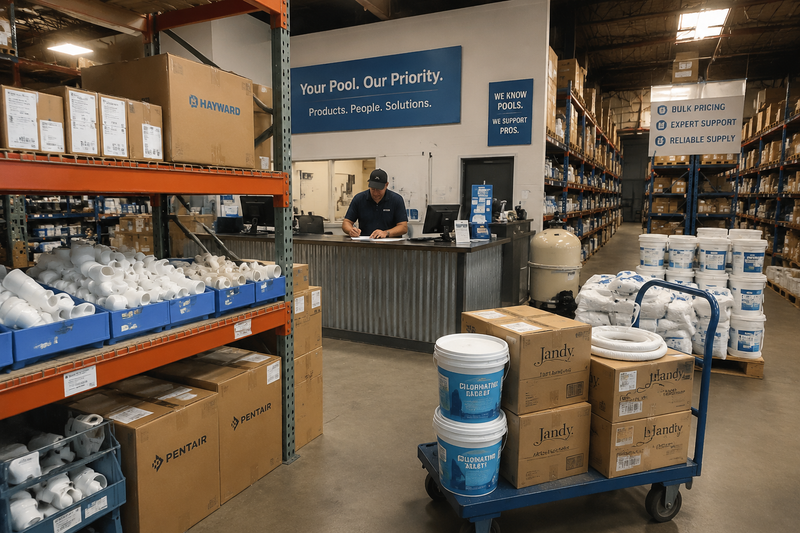
Finding the best place to buy pool supplies can feel like a constant balancing act for your pool business. You want to keep material costs low, but unreliable suppliers often lead to delayed projects, frustrating installation rework, and angry clients. The real solution lies in matching the right supplier channel to your specific operational needs and risk levels.
The best place to buy pool supplies depends entirely on what you need, your purchase volume, and how fast you need it. Local pool stores are ideal for urgent consumables. Wholesale distributors are best for routine contractor restocking. Meanwhile, direct manufacturers are the top choice for bulk equipment purchasing, long-term supply programs, and private-label OEM components.
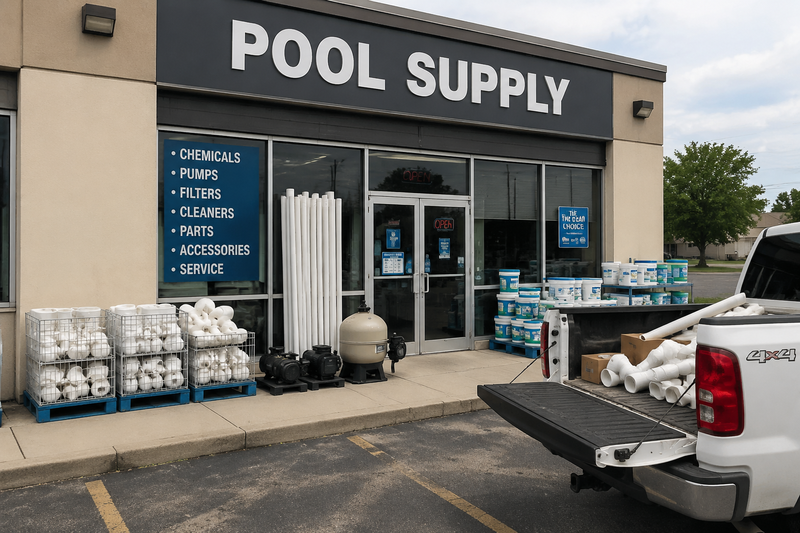
Buying liquid chlorine is very different from sourcing a smart pool automation system. Let us break down exactly where you should source different items to protect your margins, secure your warranties, and build a dependable supply chain.
Is a local retailer the best place to buy pool supplies for emergencies?
A sudden pipe leak stops your new pool installation dead in its tracks. You need specific PVC fittings immediately, but waiting on a freight shipment means losing a full day of expensive labor. Knowing your local options prevents minor job site hiccups from becoming major project delays.
A local retailer or specialized supply house is the best place to buy pool supplies when you face immediate, unexpected shortages. They offer same-day access to common consumables, standard plumbing fittings, and basic maintenance tools to keep your job site moving without costly labor downtime.
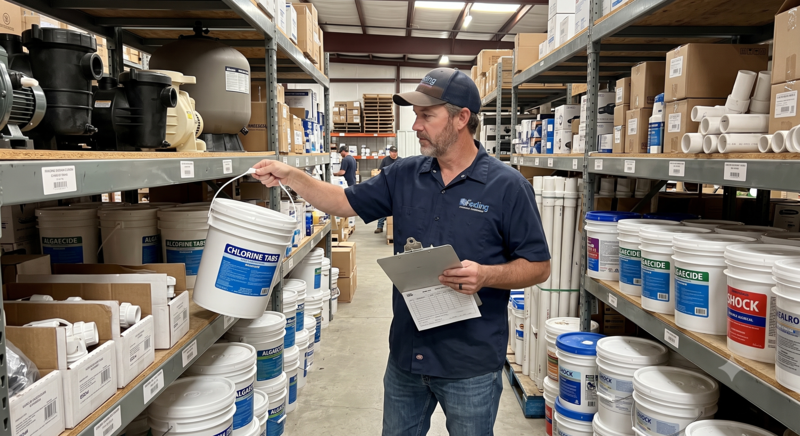
In my years of working alongside pool contractors, I see many business owners complain about the higher markup at local retail stores. However, looking only at the price tag is a mistake. For a pool builder or a maintenance company, your largest expense is usually labor, not materials1.
If you have a three-person crew standing around for four hours waiting for a specific valve, the cost of that idle time vastly outweighs the premium you pay at a local store2. I once had a client who halted a commercial salt chlorinator installation for two days because they lacked a simple 2-inch union. A quick trip to a local dealer would have solved the issue in an hour.
You should use local retail channels specifically for:
- Urgent job site shortages: Missing O-rings, broken tools, or unexpected plumbing fittings.
- Heavy liquid consumables: Small batches of liquid chlorine or muriatic acid3 where high shipping costs negate wholesale discounts.
- Client emergencies: When a homeowner needs a pool turned around for an event in 24 hours, local availability trumps wholesale pricing.
You should not rely on local stores for your core equipment procurement. Buying major hardware like pumps, electrolytic cells, or automation modules at retail prices will quickly erode your profit margins.
Are wholesale distributors the best place to buy pool supplies for routine stock?
You review your monthly inventory and realize your service trucks are constantly running low on standard replacement parts. Buying these items piecemeal at retail prices destroys your profit margins, and managing dozens of small receipts creates an accounting nightmare. You need a stable, centralized partner to manage your daily stock.
Professional wholesale distributors are the best place to buy pool supplies for your routine inventory. They provide stable bulk pricing, broad product catalogs, and dedicated account management. This allows pool contractors and service companies to consolidate orders and secure reliable margins on standard daily items.
For most established pool contractors, installers, and maintenance companies, regional wholesale distributors form the backbone of their supply chain. Distributors operate on a business-to-business (B2B) model4, meaning they understand the unique cash flow and inventory needs of service professionals.
One major advantage of using a professional distributor is the warranty buffer5 they provide. If a residential chlorinator fails in the field, returning it directly to an overseas manufacturer can take weeks. A good regional distributor will often swap the defective unit for you over the counter, handling the manufacturer Return Merchandise Authorization (RMA) process on their end. This keeps your client happy and your technicians moving.
Furthermore, distributors offer structured credit terms (like Net 306), which is critical when you are waiting on homeowner milestone payments for large construction projects.
| Feature | Local Retail Store | Wholesale Distributor |
|---|---|---|
| Primary Use Case | Urgent, same-day needs | Routine restocking & planned projects |
| Pricing Structure | Retail (Highest) | Tiered wholesale (Moderate to Low) |
| Product Range | Limited to high-turnover items | Broad catalog across multiple brands |
| Credit Options | Usually credit card only | Net 30/60 terms available for B2B |
| Warranty Support | Basic point-of-sale support | Acts as a buffer with manufacturers |
When is a direct manufacturer the best place to buy pool supplies?
Your installation business is expanding, and you want to launch your own private-label line of pool equipment. Relying on standard regional distributors means you sell the exact same brand as your competitors down the street. You need a way to stand out, control your own supply chain, and maximize your profitability.
A direct manufacturer is the best place to buy pool supplies when you need high-volume equipment, OEM/ODM customizations7, or private-label products. Buying direct gives you control over manufacturing specifications8, ensures long-term supply continuity, and connects you straight to the factory for technical support.
As a manufacturer who integrates product development, quality control, and technical support, I routinely field inquiries from pool equipment brands, importers, and spa manufacturers. They come to us because buying direct solves problems that distributors cannot fix.
When you purchase direct from a factory, you are no longer just buying a product; you are buying into a dedicated responsibility chain. For example, if you need a specialized low-salinity chlorinator for a hot tub integration, a distributor can only sell you what is in their catalog. A manufacturer can customize the chlorine-output specifications, adapt the cell plumbing design, and tailor the user interface to match your exact needs.
Manufacturers are the ideal sourcing channel for:
- OEM and ODM projects: Creating custom housings, branding, and packaging for your own product lines.
- Bulk component sourcing: Ordering large quantities of replacement cells, power modules, or pool lights.
- Smart pool integration: Sourcing display-free chlorination modules with RS485/Modbus RTU protocols9 to integrate seamlessly with third-party automation systems.
Keep in mind that buying direct requires planning. Manufacturers operate with Minimum Order Quantities (MOQs) and longer manufacturing lead times10. This channel is not for grabbing a single pump; it is for businesses ready to build a reliable, long-term sourcing strategy.
How does equipment risk dictate the best place to buy pool supplies?
You source a cheap batch of replacement parts from an unverified online marketplace to save money. Six months later, the components start failing in the field, and the anonymous seller has vanished. You now face thousands of dollars in out-of-pocket replacement costs, angry homeowners, and a damaged local reputation.
Equipment risk heavily dictates the best place to buy pool supplies. For complex components like chlorinators and automation systems, you must choose suppliers who provide clear warranty coverage, verified certifications, and robust technical support. A cheap source becomes expensive if it causes persistent installation rework.
For contractors and installers, the "best place" should always mean the lowest operational risk, not simply the lowest upfront price. When you source a product, you must ask yourself: Who confirms the model is compatible? Who supports my installers if they have wiring questions? Who actually pays for the labor if a unit fails under warranty?
Equipment purchases require much stricter vetting than basic consumables. If you buy a batch of standard pool nets, the risk is incredibly low. If the net breaks, you lose twenty dollars. However, if you source a commercial salt chlorinator or a pH/ORP monitoring system11, the stakes are significantly higher. These system-linked products interact directly with expensive variable-speed pumps, chemical dosing equipment, and home automation panels.
Before committing to a supplier for high-risk equipment, I always advise buyers to check the following:
- Compatibility Guarantees: Can the supplier verify that their replacement cells match the exact thread pitch, flow rate, and electronics of your existing systems?
- Regulatory Certifications: Does the equipment meet the strict safety and electrical certifications required in North America and Europe12?
- After-Sales Documentation: Do they provide clear installation manuals, wiring diagrams, and troubleshooting guides for your field technicians?
- Supply Continuity: Will this supplier still be manufacturing this specific part in three years when your clients need a replacement?
Reliable sourcing is ultimately about accountability. A trustworthy supplier stands behind their engineering and supports your business long after the invoice is paid.
Frequently Asked Questions
Can pool contractors buy directly from manufacturers?
Yes, pool contractors can buy directly from manufacturers, but it usually requires meeting Minimum Order Quantities (MOQs). Manufacturers prioritize bulk orders, private-label e-commerce brands, and wholesale importers rather than fulfilling single-unit retail sales for individual jobs.
Why avoid cheap online marketplaces for pool equipment?
Unverified online sellers rarely offer a clear responsibility chain. If a control board fails, you need a supplier who handles warranty claims and technical support. Cheap, anonymous marketplaces rarely offer the long-term supply continuity required for professional maintenance contracts.
How do warranties work when buying wholesale pool supplies?
Most professional wholesalers act as a warranty buffer. They handle the initial claim with the manufacturer on your behalf, often swapping the defective part immediately. This saves maintenance companies critical time and reduces friction during field service calls.
What is the best way to source replacement salt cells?
Sourcing replacement cells requires exact compatibility. You should buy these from specialized OEM manufacturers or trusted professional distributors. They can guarantee the replacement cell perfectly matches the original equipment's chlorine output, electronic requirements, and housing dimensions.
Conclusion
Deciding on the best place to buy pool supplies requires looking beyond the initial price tag. You must evaluate your purchase volume, your project urgency, and the level of technical support you require. Use local stores to solve urgent job site emergencies. Partner with regional wholesale distributors for your routine maintenance inventory. Rely on direct manufacturers for high-volume equipment, reliable warranty chains, and private-label opportunities.
If you are a pool equipment brand, importer, or distributor looking for a dependable manufacturing partner, Green Element specializes in OEM/ODM salt chlorination equipment. We handle everything from custom electronics and RS485 integration to private-label packaging. Contact us today to secure a stable, high-quality supply chain for your business.
"Construction: NAICS 23", https://www.bls.gov/iag/tgs/iag23.htm. Government labor and construction cost data identify labor as a major operating cost in specialty contracting, supporting the view that worker downtime can materially affect job profitability; the data are industry-level and do not specifically isolate pool contractors. Evidence role: statistic; source type: government. Supports: A government labor or construction cost source should show that labor is a major cost component in contractor operations, providing context for the article's labor-downtime argument.. Scope note: Contextual support rather than direct proof for every pool business. ↩
"4. Labor, Material and Equipment Utilization", https://www.cmu.edu/cee/projects/PMbook/04_Labor,_Material,_And_Equipment_Utilization.html. Research on construction productivity and delay costs shows that idle labor and waiting time can impose measurable financial losses on contractors, lending support to the article's argument that urgent local purchasing may be economically justified; the research is general to construction rather than pool-installation work. Evidence role: general_support; source type: paper. Supports: A construction productivity or delay-cost study should support that idle labor and waiting time create measurable project costs.. Scope note: Contextual support, not a direct calculation of pool-supply markups. ↩
"SP7943 - Pipeline and Hazardous Materials Safety Administration", https://www.phmsa.dot.gov/hazmat/documents/offer/SP7943.pdf/offerserver/SP7943. U.S. hazardous-materials transport guidance classifies chemicals such as sodium hypochlorite solutions and hydrochloric acid as materials requiring regulated handling during shipment, supporting the article's explanation that shipping small chemical quantities can add logistical cost; it does not by itself compare retail and wholesale prices. Evidence role: mechanism; source type: government. Supports: A hazardous-materials transport source should show that sodium hypochlorite and hydrochloric acid are regulated or hazardous chemicals requiring special handling in transport.. Scope note: Supports the shipping-cost mechanism, not the exact price outcome. ↩
"Monthly Wholesale Trade", https://www.census.gov/wholesale/. Government industry classifications define wholesale trade as the distribution of goods to businesses, institutions, and other non-consumer purchasers, supporting the article's characterization of distributors as B2B intermediaries. Evidence role: definition; source type: government. Supports: A government industry-classification source should define wholesale trade as selling goods to businesses or institutional buyers rather than final consumers.. ↩
"After-Sales Service | Privacy Shield", https://www.privacyshield.gov/ps/article?id=Providing-After-Sales-Service. Supply-chain and distribution-channel research describes intermediaries as performing coordination, service, and reverse-logistics functions between producers and buyers, supporting the article's description of distributors as a possible warranty buffer; the literature does not prove that every pool distributor offers immediate over-the-counter replacement. Evidence role: general_support; source type: paper. Supports: A supply-chain or marketing-channel paper should support that distributors and intermediaries may provide after-sales service, returns handling, or coordination between manufacturers and customers.. Scope note: Contextual support; service policies vary by distributor and product. ↩
"How Net 30 Accounts Help Conserve Business Cash Flow", https://www.sba.gov/blog/how-net-30-accounts-help-conserve-business-cash-flow. Small-business finance guidance treats supplier trade credit, including payment terms such as Net 30, as a short-term financing tool that can help firms manage cash flow between purchasing inputs and receiving customer payments. Evidence role: definition; source type: government. Supports: A government small-business finance source should define trade credit or Net 30 terms and explain their role in short-term business financing.. ↩
"Original design manufacturer", https://en.wikipedia.org/wiki/Original_design_manufacturer. Academic and educational descriptions of OEM and ODM manufacturing distinguish contract production from design-and-manufacture arrangements, supporting the article's use of these terms for customized direct-manufacturer sourcing. Evidence role: definition; source type: education. Supports: An educational or academic source should define OEM and ODM manufacturing models and their connection to customized production or design services.. ↩
"Examining collaborative buyer–supplier relationships and social ...", https://pmc.ncbi.nlm.nih.gov/articles/PMC9434505/. Research on supplier integration and buyer-supplier collaboration finds that direct engagement with manufacturers can improve specification alignment and support product customization, providing contextual support for the article's claim about greater control over manufacturing specifications. Evidence role: general_support; source type: paper. Supports: A supply-chain or product-development paper should show that direct supplier involvement can support customization, specification alignment, or design collaboration.. Scope note: The evidence is general to manufacturing relationships and does not prove the terms offered by any specific pool-equipment factory. ↩
"Modbus", https://en.wikipedia.org/wiki/Modbus. Technical reference sources describe Modbus RTU as a serial communications protocol commonly used with RS-485 physical links in industrial control and automation systems, supporting the article's description of these protocols as integration mechanisms; this does not establish compatibility with any particular pool controller. Evidence role: definition; source type: encyclopedia. Supports: A neutral technical reference should define Modbus RTU and RS-485 as serial communication technologies used in automation and device communication.. Scope note: Defines the protocol context, not product-specific interoperability. ↩
"Raw Material Minimum Order Quantity Optimization", https://dspace.mit.edu/bitstream/handle/1721.1/121302/1240293813-MIT.pdf?sequence=1. Operations-management sources define minimum order quantities as supplier-imposed purchase thresholds and treat manufacturing lead time as the elapsed time required for production and delivery, supporting the article's caution that direct factory purchasing requires advance planning. Evidence role: definition; source type: education. Supports: An operations-management or supply-chain source should define minimum order quantities and explain that manufacturing procurement involves production and delivery lead times.. ↩
"2023 Model Aquatic Health Code", https://www.cdc.gov/model-aquatic-health-code/media/pdfs/2023-MAHC-508.pdf. Public-health guidance for aquatic venues describes pH and oxidation-reduction potential as key water-chemistry parameters used to monitor and manage disinfection, supporting the article's classification of pH/ORP systems as technically important components; the guidance is aimed mainly at aquatic-facility operation rather than procurement risk. Evidence role: mechanism; source type: government. Supports: A public-health or aquatic-facility guidance source should explain that pH and ORP are monitored to manage disinfection and water chemistry, sometimes through automated control systems.. Scope note: Supports technical importance, not supplier-selection outcomes. ↩
"OSHA's Nationally Recognized Testing Laboratory (NRTL) Program", https://www.osha.gov/nationally-recognized-testing-laboratory-program. Regulatory sources in the United States and European Union require electrical equipment to meet applicable safety requirements or recognized conformity procedures, supporting the article's advice to verify certifications for higher-risk pool equipment; specific certification marks depend on product category and jurisdiction. Evidence role: general_support; source type: government. Supports: Government regulatory sources should show that electrical equipment placed on the market or used in workplaces must meet applicable safety requirements or recognized standards.. Scope note: Contextual regulatory support; exact requirements vary by market and device. ↩